Quick Answer
Kaiping Diaolou is a practical one- or two-day heritage trip for travelers interested in architecture, migration history, and rural villages. UNESCO lists 20 representative diaolou across four component groups, while the main visitor attraction groups Zili Village, Majianglong, and Li Garden.
For a first visit, use Zili Village and Li Garden as the core pair. Add Majianglong if the current tourist line or a driver makes the connection workable. Give Jinjiangli its own half-day if you want the most complete village-cluster experience.
The towers are scattered rather than concentrated in one walkable district. One long day is possible with confirmed transport; two days is the calmer choice.
Why This Place
Diaolou are multi-story defensive village buildings that combine Chinese construction traditions with architectural forms brought back by overseas Kaiping communities. UNESCO recognizes three broad building roles: communal refuge towers, fortified residences, and watchtowers.
The heritage site and the official visitor attraction are related but not identical. UNESCO's four components are Sanmenli, Zili Village and the Fang Clan Watch Tower, Majianglong, and Jinjiangli. Li Garden is a major part of the 5A visitor attraction, but it is not one of those four UNESCO components.
Who It Fits
Choose Kaiping if you like:
- Architecture.
- Overseas Chinese history.
- UNESCO villages.
- Photography.
- Short side trips from the Pearl River Delta.
It is less suitable if you want nightlife, a single compact attraction, or a trip that can be completed entirely on foot.
What to See
Zili Village: best first stop
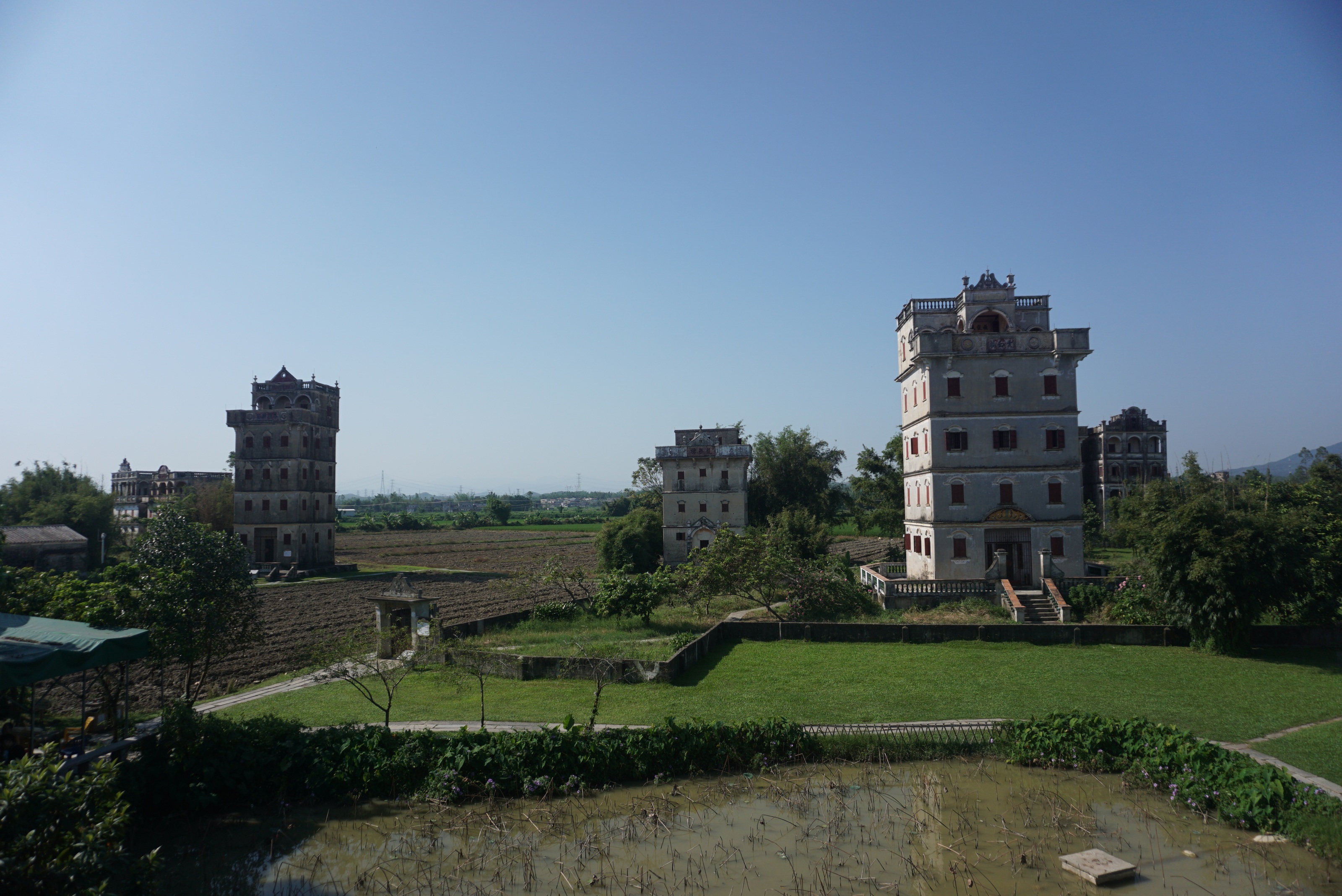
Zili is the clearest introduction to the UNESCO landscape: towers and village houses sit among ponds and farmland. Make this your first choice if you can visit only one diaolou cluster.
Li Garden: add for designed gardens and villas
Li Garden combines a private garden, villas, covered walkways, and Chinese and Western design. It belongs to the official 5A tourism area but is not one of the four UNESCO component groups. Pairing it with nearby Zili gives a first-time visitor two different types of architecture without adding the more distant Jinjiangli transfer.
Majianglong Village Cluster: choose for the landscape
Majianglong places its towers and villas among bamboo and mature trees. Choose it over Li Garden if you care more about a lived-in village landscape than a formal garden.
Jinjiangli: reserve time for the separate transfer
Jinjiangli is in Xiangang Town, about 22 kilometers northeast of central Kaiping. Its three principal towers are Ruishi Lou, Shengfeng Lou, and Jinjiang Lou. It is not included in the documented four-stop tourist line, so treat it as a separate transfer and allow its own half-day.
Chikan: an optional old-town stop
Chikan is not part of the UNESCO diaolou property, but local-government route information places it on the tourism line between Li Garden and Majianglong. Add it for arcade streets and overseas Chinese heritage only after checking its current admission, opening hours, and transport.
How Many Days
One long day: Zili Village + Li Garden, then Majianglong if current transport and opening hours allow.
Two days and one night: Zili Village + Li Garden on day one; Majianglong + Jinjiangli on day two. A driver makes the second day much easier.
Do not build a one-day plan around all four UNESCO components. Sanmenli and Jinjiangli are outside the core three-part visitor attraction, and the transfer time removes most of the value of rushing through every stop.
How to Get Around
Treat Kaiping as the transport base and solve the village transfers before you arrive. The major sites are not within walking distance of one another.
Local-government pages document a 5A tourist line linking Zili Village, Li Garden, Chikan, and Majianglong. The detailed timetable and free fare published in 2024 were explicitly for a trial period. A 2025 government report still described the route, but it did not provide a current timetable. Check the official Kaiping Diaolou Cultural Tourism Area channel shortly before travel; if the timing is uncertain, arrange a car or driver.
Jinjiangli is not listed on that four-stop line. Plan it as a separate transfer rather than assuming the tourist bus will reach it.
Best Season
October through March is our practical recommendation for avoiding the hottest part of the year during long outdoor walks. Kaiping's 2025 official weather summary recorded its annual high in July and tropical-cyclone effects through September; conditions vary by year, so check the forecast. In warmer months, start early, carry water, and leave more time between outdoor village sections.
Practical Difficulty
The sightseeing itself is easy; the scattered geography makes the trip moderately difficult without a car. Save these Chinese names for map searches and driver communication:
- 自力村碉楼群 — Zili Village Diaolou Cluster
- 立园 — Li Garden
- 马降龙碉楼群 — Majianglong Village Cluster
- 锦江里碉楼群 — Jinjiangli Diaolou Cluster
- 赤坎华侨古镇 — Chikan Overseas Chinese Ancient Town
Common Mistakes
Treating Li Garden as a UNESCO component
Li Garden is a core part of the 5A tourism area, but the UNESCO serial property consists of Sanmenli, Zili, Majianglong, and Jinjiangli. This distinction matters when you choose between a convenient visitor circuit and a heritage-completion trip.
Copying an old shuttle timetable
The detailed 2024 notice described trial service and said later schedules would be adjusted. Confirm the current route, timetable, and fare instead of planning around screenshots or old blog posts.
Adding Jinjiangli without allowing for the transfer
Jinjiangli is farther from the core visitor circuit. Give it a separate half-day and arrange transport in advance.
Fit It Into a Route
- Guangzhou + Kaiping.
- Jiangmen + Kaiping.
- Kaiping + Macao SAR or Hong Kong SAR only if you have enough time and understand border and transport logistics.
- Kaiping + Fujian Tulou for an architecture theme, but this requires a larger southern China route.
Related setup guides
- Fujian Tulou Guide — another village-architecture heritage route.
- Quanzhou Guide — coastal heritage and old port culture.
- How to Book Hotels in China — confirm foreign-passport check-in outside major cities.
Sources & Verification
All factual claims in this guide are verified against the primary sources listed below. Official Chinese government sources take priority.
- Kaiping Diaolou and Villages — UNESCO World Heritage Centre listing; verifies the site's heritage value, inscription date, and four-group serial-property structure. English authoritative source.
- Kaiping Diaolou nomination document — UNESCO nomination file; identifies Sanmenli, Zili and the Fang Clan Watch Tower, Majianglong, and Jinjiangli as the four nominated components. English primary heritage record.
- 5A tourist attraction: Kaiping Diaolou Cultural Tourism Area — Ministry of Culture and Tourism data service; verifies that the visitor attraction comprises Zili Village, Majianglong, and Li Garden, and describes their different settings. Chinese official source.
- Kaiping tourism directory: Kaiping Diaolou Cultural Tourism Area — Kaiping Municipal People's Government, May 31, 2023; detailed Chinese-language descriptions of Zili Village, Majianglong, and Li Garden. Chinese local-government source.
- Kaiping May Day tourism report — Kaiping Municipal People's Government, May 7, 2025; records the 18-kilometer 5A tourist line linking Zili Village, Li Garden, Chikan, and Majianglong. Chinese local-government source.
- 5A tourist-line trial notice — Jiangmen Culture, Radio, Television, Tourism and Sports Bureau, September 18, 2024; confirms the four-stop route and that the published timetable and free fare applied to a trial period. Chinese tourism-bureau source.
- Jinjiangli Diaolou Cluster — Jiangmen Culture, Radio, Television, Tourism and Sports Bureau, September 2, 2026; verifies Jinjiangli's location and its three principal towers. Chinese tourism-bureau source.
- Kaiping physical geography, 2025 — Kaiping Municipal People's Government, April 8, 2026; provides the latest annual temperature, high-heat, rainfall, and tropical-cyclone context used for the seasonal recommendation. Chinese local-government source.